Galicia
Felix AustriaGalicia is the eastern Habsburg borderland that gives Felix Austria its social and historical scale: a prosperous, multilingual region where intimate household dramas unfold amid cultural plurality, imperial ceremony, and signs of a political order beginning to fracture. The novel’s vision of Galicia holds two images together—the remembered promise of a tolerant, flourishing Austria and the material inequalities and historical pressures that make that promise precarious.
Setting and Social Texture
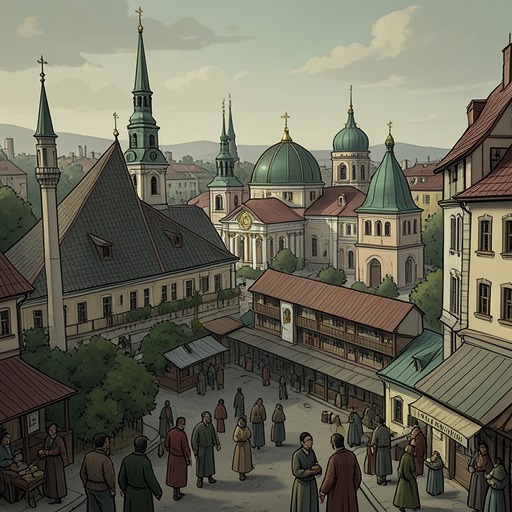
Around 1900, Galicia belonged to the Austro-Hungarian Empire, and Stanislaviv was one of its cultural capitals. The novel presents the region through the perspective of a young woman employed as a cook in a wealthy household. Her daily world connects domestic service and private feeling to a society composed of different ethnicities, languages, and religions. People pursue loves that are not returned, hide secrets in cupboards, take an interest in science and magic shows, and gather for balls and carnivals. This variety makes Galicia feel both self-contained and strikingly diverse: the apparent quiet of provincial life contains many competing customs and private histories.
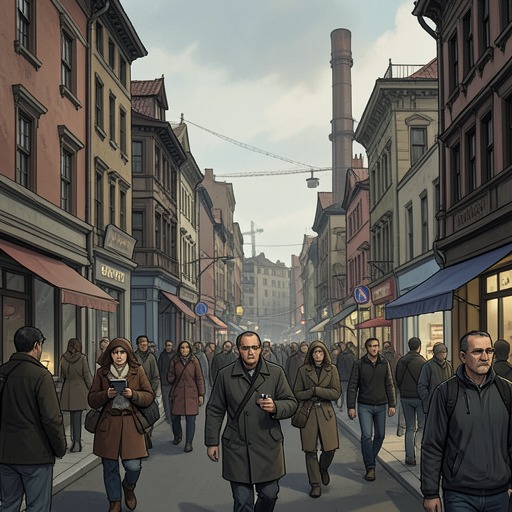
That diversity does not amount to equality. On a journey through the city, Ukrainian cries, Polish mockery, and German reproaches sound together, while the streets lead from shops selling imported goods to crowded, muddy lanes lined with workshops and poor wooden houses. Young rabbis in black satin, fur-trimmed hats, and brilliant white stockings argue and pray near the synagogue; elsewhere, sellers hawk remedies, soap, preserves, and household wares. These contrasts place religious and linguistic plurality beside sharply unequal living conditions. Galicia’s social richness is real, but so are the boundaries of class and circumstance that shape who enjoys the city’s prosperity.
Imperial Belonging and Its Performance
The empire makes its presence visible in public ceremony and familiar emblems. In 1900, Stanislaviv decorated itself with flowers and banners for the seventieth anniversary of Emperor Franz Joseph I’s birth. A local newspaper praised the emperor as protector and credited his rule with allowing Galicia a voice equal to other crown lands and the freedom to develop. The celebratory language presents imperial inclusion as a historical correction: the region, the paper claims, had previously endured material destruction, moral humiliation, and cultural neglect.
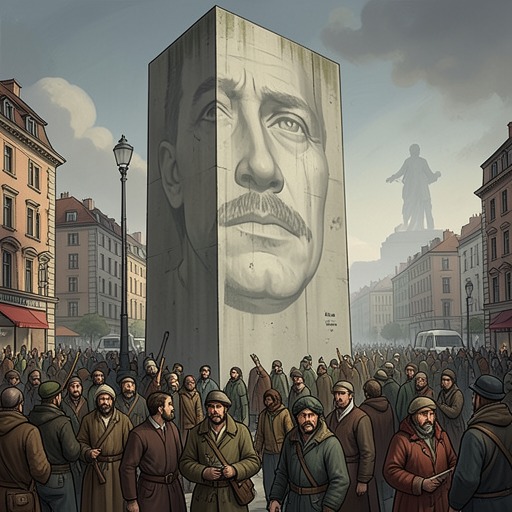
The city’s imperial symbols reach even its poorest districts. Portraits of the emperor and the crowned double-headed eagle hang above streets where mud rises to the knees and families live amid refuse, crowded courtyards, and decaying buildings. The inscriptions “Indivisibiliter Ac Inseparabiliter” and “Felix Austria” assert unity and happiness at the very moment the surrounding scene exposes hardship. The juxtaposition makes imperial belonging both a powerful shared image and an incomplete account of life under the monarchy.
Strain Beneath Prosperity
The novel repeatedly sets assurances of stability against evidence of vulnerability. The Swabian community’s organization, intelligence, and hard work cannot prevent impoverishment; its members discuss repairing carts, greasing wheels, and acquiring strong young horses and oxen so they can leave for other lands. Their decision to emigrate turns economic hardship into a physical departure from Galicia, and the accompanying image of prayer as tears rising to heaven gives their hope a note of grief rather than confidence.
Political events elsewhere in the empire and beyond also unsettle the language of benevolent order. In a discussion of international affairs, a speaker recounts American violence in the Philippines, British ambitions in South Africa, and the suppression of the Boxers in China. Petro challenges the claim that intervention is merely neighborly assistance: great powers, he observes, describe military action as a way to restore order while taking up arms against people seeking to retain ancestral beliefs. The conversation brings distant imperial violence into the domestic social world and complicates the region’s official image of protection and progress.
The Myth of Felix Austria
For the novel, “Felix Austria”—happy Austria—is at once a name for a lost world and a claim that its history cannot bear without qualification. Galicia evokes a Central Europe remembered as tolerant, prosperous, and multicultural, but that recollection sits beside poverty, emigration, unequal conditions, and the force used by empires abroad. The tension is also compressed into the narrator’s declaration that her love is as eternal and unchanging as the Austro-Hungarian Empire: a private faith in permanence echoes the public myth just as the surrounding story exposes what both forms of certainty conceal.
The novel’s ending sharpens that irony. As the house fills with smoke and the objects within it melt and disappear, the narrator recognizes the illusion in which she has lived. The collapsing home does not simply stand for Galicia, but its destruction resonates with the book’s wider movement from the reassuring image of an enduring order toward recognition of fragility. Galicia is therefore more than a historical backdrop: its contrasts give the intimate plot a political horizon and make nostalgia for imperial happiness inseparable from awareness of the cracks beneath it.